 The ESSENTIAL Football Show
Top 51 Cap Space (per Spotrac): 2026: $41.1 million | 2027: $61.1 million | 2028: $194.2 million
Draft Picks: 2027: 1-5, LAR 7 | 2028: 1-7, NYJ 7
Football Decision Makers: GM Joe Hortiz | HC Jim Harbaugh | OC Mike McDaniel | DC Chris O’Leary | ST Ryan Ficken
State of the Team
Looking back at 2025, the Los Angeles Chargers have some “only if” moments. This started in the preseason, when left tackle Rashawn Slater went down with a knee injury, and went into full free-fall when fellow tackle Joe Alt - who had kicked to the left side to replace Slater and was arguably the most dominant player at ANY position in football - suffered his first high ankle sprain of the season. Alt would return, only to re-injure the same ankle, and once he was gone, the offensive line was in total shambles, with Bobby Hart, who was in his prime on the Mitchell Trubisky Chicago Bears teams, coming out of nowhere to play significant snaps.
It’s a plus that the Chargers have made the playoffs in back-to-back years, but with the way they were fading down the stretch, it’s hard to say last year was anything but a disappointment, and that’s compounded by the fact that standout defensive coordinator Jesse Minter capped a quality season on his side of the ball by taking the head coaching job for the Baltimore Ravens.
However, for as good as Minter is, I think that last year’s tumult might have left the Chargers in a better place, because after moving on from Greg Roman, Jim Harbaugh hired Mike McDaniel to be his offensive coordinator, and I think we’re about to see some major fireworks out West.
Offense
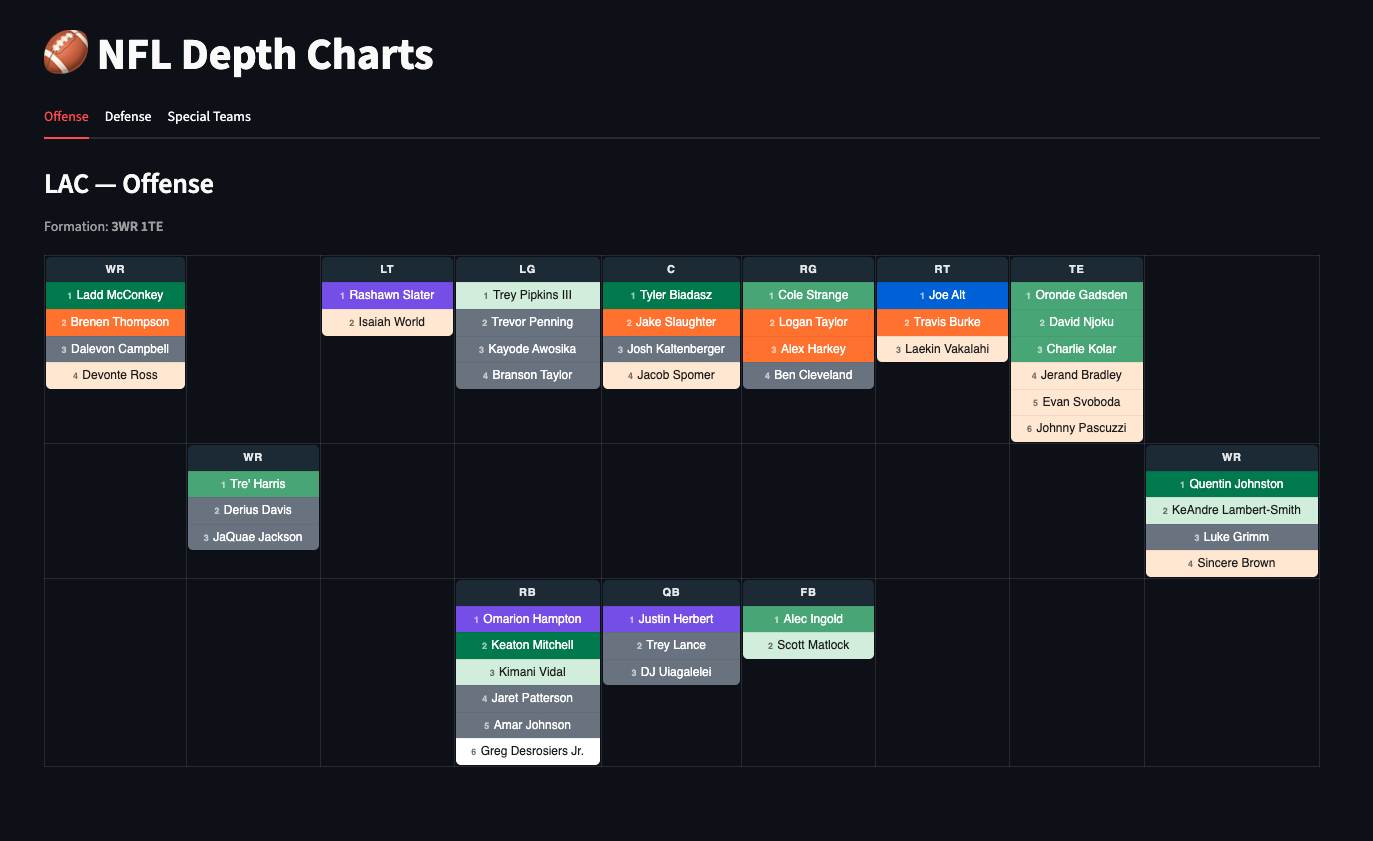
I get a kick out of hearing folks map Chargers players into role’s in “McDaniel’s scheme”, whether it be the “Tyreek role”, the “Waddle role”, or anything else.
If you can find me one person who had ANY idea what that Miami offense, which McDaniel had tailored to quarterback Tua Tagovailoa’s specific game and the strengths of his two receivers, was going to look like, you’re a more thorough researcher than me. McDaniel took the NFL by storm with an offense that operated very differently than McDaniel’s former team, the 49ers had, and if you think that’s because McDaniel wanted to run those specific play designs, rather than the play designs appearing as a result of the available personnel, then I think you’re missing the point. McDaniel doesn’t have “an offense”; he is an offensive innovator who is continuously tweaking designs, particularly in the run game, to maximize whatever personnel he has to hand at the time.
That’s not to say there won’t be any overlap between what Ladd McConkey and Quentin Johnston do with what Tyreek and Waddle did - they are all playing receiver in the NFL, after all - but if you think McDaniel walked into the Chargers facility with a binder of plays and told everyone else to start learning while he took in the sun, then I think the Week One tape might take you by surprise.
Not only do the Chargers have a very different quarterback in Justin Herbert, they have different players around him. For his part, Herbert is a prototype at the position, and an outstanding player; he has his doubters, but I’d compare Herbert to Matthew Stafford in Detroit as a clearly dominant player who is taking the rosters around him as far as they can go.
As for that roster, it starts with the tackle duo. If Joe Alt is healthy, he’s the best offensive player in football; Alt was weaponized in the run game, dominating at both the point of attack and on the move, and with his combination of physical traits, movement skills, mental acumen, and technique, I don’t know where you’re going to find more dominant film than Alt’s Year Two stuff. In pass protection, Alt plays with incredible sink through his hips, knees, and ankles, and because he is playing in such a low stance, the “reaching down” issue that some tall offensive linemen get into is flipped; rather than angling his punch down, Alt gets himself on a similar plane to the pass rusher in front of him, allowing him to maximize his impressive reach to keep pass rushers on the “long route around the city”, so to speak.
Slater isn’t on that level, but he’s a borderline elite player when healthy, and the interior is likely to be more sorted this season; Tyler Biadasz is a solid veteran addition at center, guard Cole Strange comes with McDaniel after a successful run in Miami, and while there isn’t a clear-cut starter at left guard, the Chargers have options; Trey Pipkins and Trevor Penning are veterans with a lot of reps under their belts (even if they aren’t the most impressive reps), Kayode Awosika adds some veteran depth to the room, and second-round pick Jake Slaughter, a college center who is also competing at guard, gives them multi-position depth. Throw in the fact that McDaniel is among the NFL’s best at giving his linemen advantages and scheming to their strengths, and I’d expect this group to be significantly improved; because the Miami offense expressed itself through Hill and Waddle, I think it’s easy to get caught up in the passing game stuff, but McDaniel is first and foremost a run game savant.
On the skill side, McDaniel has a potential superstar in second-year back Omarion Hampton, who brings ultra-explosive traits to the table, and a lot of solid/plus talent around him. The Chargers added speedster Keaton Mitchell to the backfield, and while Mitchell lacks vision as a runner in the backfield, there are few players more explosive than him once they are in space, and McDaniel specializes in that. Orande Gadsden was already in place as a receiving tight end who can displace to the slot and play on the move, and Los Angeles added a pair of “two-way” options in Charlie Kolar and David Njoku, the latter of whom was seemingly a total afterthought in free agency; Njoku was a first-round pick back in 2017, but this is still only his age-30 season, and he’s continued to be productive despite being in a dreadful Cleveland offense.
The receiving group has a lot of specific players; I got overhyped on Ladd McConkey coming out of his rookie season, because while McConkey is a really good player, he’s ultimately 6’0 and 185 pounds, and that puts a certain limit on his talent. On the flip side, Quentin Johnston clocks in at 6’3 and 210, and while he doesn’t change direction nearly as well as McConkey, he has developed into a player who uses his frame and stride length well on “runway” routes. Ultimately, I think McConkey and Johnston both have their fits, but I’m not taking it for granted that the offense will be as concentrated as it was for Hill and Waddle in Miami, because Hill and Waddle are both better players; the Chargers also have Tre Harris, their 2025 2nd-round pick, who is somewhere between McConkey and Johnston as a bigger (6’2, 210) receiver who changes direction better than Johnston. Harris lacks the 4.4-flat speed of Johnston and McConkey, which also speaks to the makeup of this receiving room; there are a lot of good players with different skillsets, and I expect McDaniel to work into the talent in his depth.
Defense
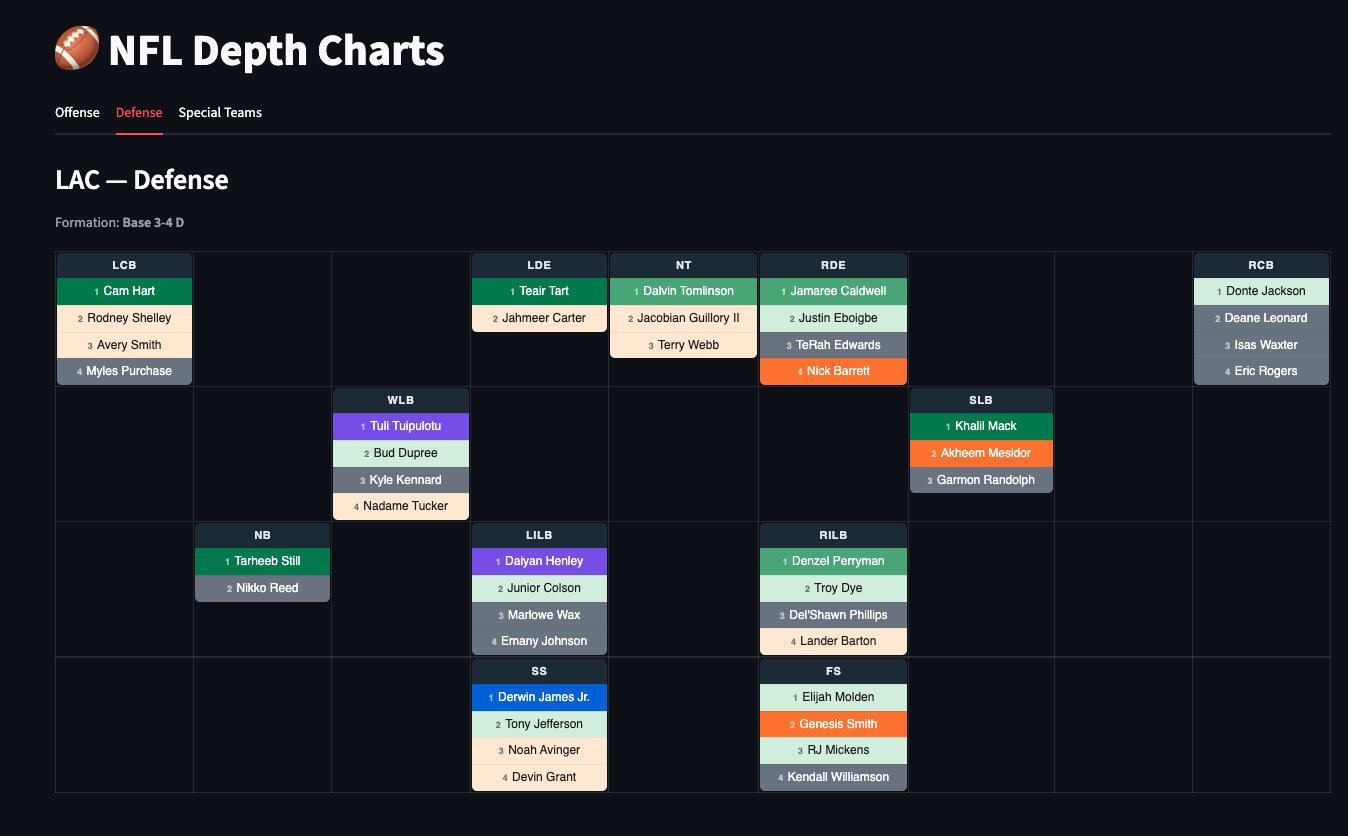
The Chargers defense is a “greater than the sum of the parts” type of operation; the unit is lacking in super high-end talent, but they are deep, and by playing in a rotation, they are able to play with a consistently high level of effort across the board.
This starts up front, where veteran defensive tackle Dalvin Tomlinson joins Tear Tart and Jamaree Caldwell in the interior rotation, and 1st-round pick Akheem Mesidor joins Khalil Mack and Tuli Tuipulotu in the edge room. Those trios highlight the interior and edge, but the Chargers will likely get quality snaps from others; as an example, Bud Dupree sticks out to me as a player who has quietly given the Chargers his share of solid snaps. Dupree played 50% of the snaps in 2024 and 41% in 2025, and while he isn’t lighting up the box score, he is doing a lot of hard things for them and providing a solid, physical presence on the edge.
The stars of the unit are in the middle, where Daiyan Henley is a rangy presence at off-ball linebacker and Derwin James is a moveable chess piece in the back end. There are a lot of quality players around them; Denzel Perryman does a nice job in the run game at inside backer, and Tony Jefferson and Elijah Molden, while not the flashiest safety duo, are solid enough to put a top on this two-high structure.
At cornerback, the Chargers once again have good players even if they lack a lockdown player. Tarheeb Still and Cam Hart, a pair of 2024 5th-rounders, have already wildly outperformed their draft slots heading into their third season, and veteran Donte Jackson continues to play solid ball when injuries aren’t keeping him off the field.
Departed coordinator Jesse Minter did a great job with this unit, and you don’t want to discount the value of that position; that said, I think the gap between Minter and new defensive coordinator Chris O’Leary, who had experience with the Chargers before a one-year sojourn to be the defensive coordinator at Western Michigan, is likely to be smaller than the one between McDaniel and Roman on the offensive side, so the Chargers likely come out ahead there.
Final Takeaways
Health is a big question for this group after Slater and Alt’s respective injuries last year, but it’s hard to overstate how exciting this offensive unit could be to watch if everything comes together.
Not to overemphasize the Stafford comparison, but it strikes me as apt; Stafford is too talented to have “bad” seasons, but his fortunes rose and fell with both the talent and the offensive environment around him, and while he hasn’t found another Calvin Johnson in Los Angeles, Stafford’s connection with Sean McVay, and the way they have been able to push and evolve the scheme with some pretty good players of their own, has allowed the quarterback to reach new heights in his career.
This time it’s the coach switching positions rather than the quarterback, but it comes to the same thing: a quarterback-offensive designer partnership that could run one of the NFL’s better offenses, and if all goes well, Super Bowls and MVPs.