 The ESSENTIAL Football Show
Top 51 Cap Space (per Spotrac): 2026: $28.1 million | 2027: -$39.3 million | 2028: $83.1 million
Draft Picks: 2027: 1-5, CLE 6, NE 7 | 2028: 1-5, 7, NO 7
Football Decision Makers: GM Nick Caserio | HC DeMeco Ryans | OC Nick Caley | DC Matt Burke | ST Frank Ross
State of the Team
As C.J. Stroud and Will Anderson enter their 4th season in the NFL, it’s fair to say it’s been a mixed bag for the organization. The team itself has had positive moments - they’ve won a playoff game each season this tandem has been on the squad - and Anderson has developed into a bonafide superstar as one of the league’s premier defensive ends.
The downside is, for all of the positives, and the defense establishing itself as a truly elite unit over the past two seasons, the Texans have continued to feel more like a “playoff contender” than a “championship contender.” It’s possible that they would have reached the Super Bowl had they found a way past the Patriots, given the circumstances in Denver, but the offense ultimately felt lacking throughout the season.
That has shifted the focus to Stroud, his performance in the context of the offense, and his pending contract situation; the Texans have a massive amount of money committed to future versions of this team, which is a positive in that it means they have a significant amount of elite talent secured for the foreseeable future, and a negative in that they have limited levers to pull to adjust the roster moving forward.
The quarterback will be the same, but the offense has had an overhaul; running back David Montgomery is the biggest name addition given his position, but just as important may be the three new players along the offensive line. If the offense can become more consistent - and frankly, resilient - the Texans could well push things over the top given the talent on their defense.
Offense
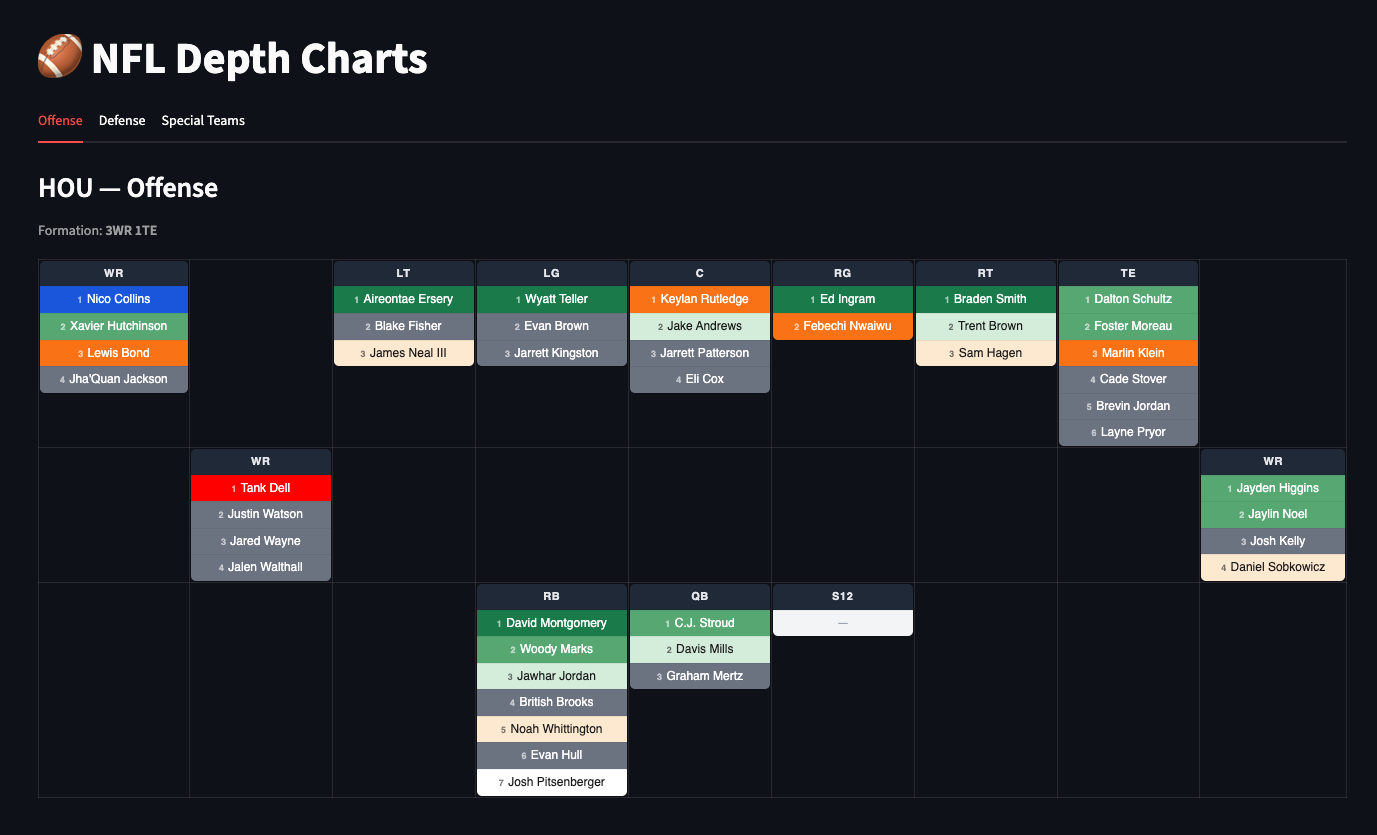
After a truly enjoyable rookie season, C.J. Stroud’s film has become progressively more frustrating to watch over the past two years, but before I get into the negatives, it is worth noting that this is not a hopeless situation. If we rewind to Week 17, we can watch Stroud play a quality opening quarter against a tough Chargers defense on the road, and while he didn’t sustain that play wire-to-wire, it was a nice reminder that Stroud can still hit his shots in the right circumstances.
The Texans are going to need more than that, however, and I think the improvements need to come from both Stroud himself and the situation around him. As far as Stroud goes, he needs to, first and foremost, recapture his ability to make throws under pressure. This was something I remember being excited about in his game as a rookie, but as time has worn on and the hits have piled up, Stroud has started to look tentative when anticipating a hit; for a player to player comparison, I would point to Derek Carr as a recent quarterback who threw the ball well, processed the game effectively, and had some mobility when he really needed it, but was ultimately limited by his lack of aggression. I’d say similar things about Stroud, and it will be interesting to see if he can find a way past that particular issue.
There’s a chance that could happen if the offensive line plays up to its ceiling; the issue is that left guard Wyatt Teller, who was an elite player at his peak, and right tackle Braden Smith, who was a plus player for years, have both struggled with injuries in recent years. If they are out there, and first-round pick Keylan Rutledge is a hit at center, this group could be pretty darn good; Ed Ingram has established himself as a quality run blocker and overall solid right guard, and Aireontae Ersery is a talented young player who is trending up and could be a “plus” player in the upcoming season. There is depth as well - Jake Andrews has started a lot of games for this team at center and Trent Brown is in the wings as a swing tackle - but if the Teller, Smith, and/or Rutledge additions don’t work out for one reason or another, Houston could find themselves right where they were last year along the line.
The skill players should be a bright spot; Nico Collins is an elite player at receiver, and the duo of Jayden Higgins and Jaylin Noel both had moments in their rookie season and fill in well around Collins for skillsets in a three-receiver set. The tight end room has two adequate veterans in Dalton Schultz and Foster Moreau, and the hope is that second-round pick Marlin Klein winds up playing a role as well. Montgomery slots in as the lead back; his solid all-around game should allow them to use the elusive Woody Marks in spots best suited to his skillset, and if Montgomery does go down, Jawhar Jordan flashed down the stretch as a back who can contribute to a room, even ripping off a 100-yard game against the Arizona Cardinals. If Tank Dell returns from his devastating knee injury and is able to contribute, so much the better, but there should be enough here to see better results on offense even if Dell can’t make it back out there.
Defense
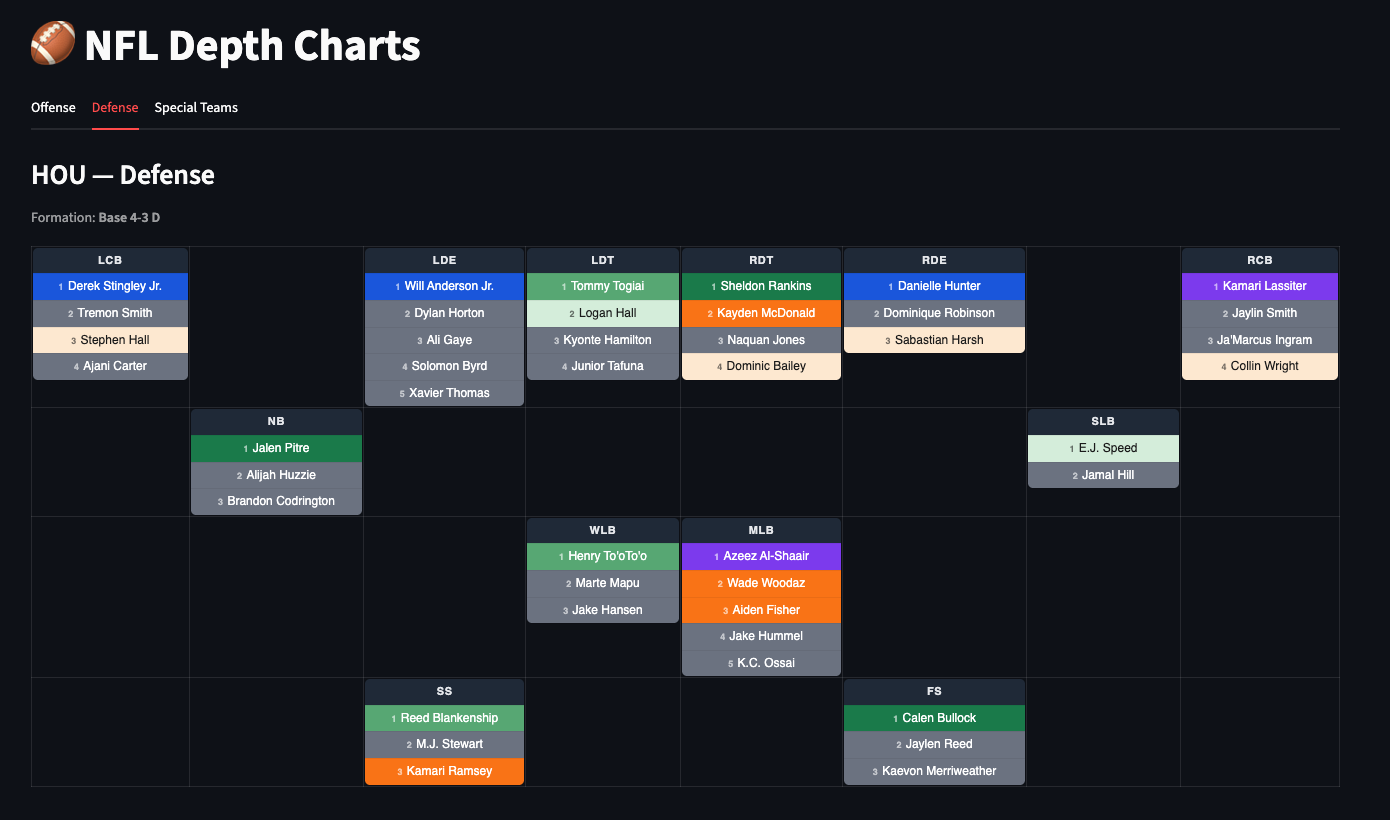
The Texans defense is STACKED with blue and purple players, there are no notable holes, and if history is any indicator, the depth chart will feature some unexpected green players (of one variety or another) by season’s end.
Pretty good place to start, right?
The job that head coach DeMeco Ryans and defensive coordinator Matt Burke have done with this unit is phenomenal. Their three blue-chip players - the defensive end duo of Will Anderson and Danielle Hunter and cornerback Derek Stingley Jr. - would be studs in any system, but they have also turned a second-round corner (Kamari Lassiter) and a linebacker who hadn’t fit in his lone season with the Titans (Azeez Al-Shaair) into plus players, and players like defensive tackle Sheldon Rankins have made notable positive contributions in Houston despite struggling to fit with other teams.
It’s hard to say whether the coverage or pass rush is more dominant, so I’ll go back to front; the Texans have a dominant corner duo with Stingley and Lassiter, and both players are well-rounded, so there’s no need for them to flip sides and follow receivers. Stingley is the better known quantity, but Lassiter is an incredibly impressive player in his own right; despite the poor 40 time that caused him to drop in the draft, he has no problems sticking with receivers vertically from press or off coverage, he consistently challenges receivers at the catch point, and he’s a terrific tackler. Their nickel back, Jalen Pitre, is a versatile piece effectively operating as the third linebacker, and at safety, free-agent acquisition Reed Blankenship is another solid addition next to Calen Bullock, who is one of the best “center fielders” in the NFL when asked to line up in single high; arguably a “plus” player already, Bullock’s instincts breaking on passes over the middle pair with Stingley and Lassiter’s outside cover ability to make any throw to the deep areas a challenge.
Linebacker is the weak point, but that’s a relative statement; Al-Shaair possesses terrific range and instincts, Henry To’o To’o is an adequate player (if a bit lacking in traits), and the tandem of veteran E.J. Speed and fourth-round pick Wade Woodaz give them a couple options if either starter goes down in this nickel-heavy defense.
Up front, Will Anderson has developed into an utterly dominant two-way player and is on track to be in the discussion as the NFL’s premier defensive end when Myles Garrett slows up a tick, and Danielle Hunter is elite in his own right. The interior duo of Rankins and Tommy Toga, a very capable run-stuffer, will be backed up by second-rounder Kayden McDonald, who is supposed to be a force against the run, and Logan Hall, a former first-rounder from Tampa Bay who has been an adequate NFL player; given the history in Houston, I would not be vaguely surprised if Hall plays the best ball of his career and winds up with 5-8 sacks. They also made an interesting add at defensive end in Dominique Robinson, Robinson flashed out of the gate as a fifth-round pick for Chicago years ago, but has never turned into a consistent producer during his four seasons. With physical dimensions similar to Hunter, I could see Robinson picking up a few tips from Hunter that could allow Robinson to contribute more and replace the five sacks the Texans got from Derek Barnett last season. (Barnett is still a free agent, so a reunion is not out of the question, either.)
Final Takeaways
C.J. Stroud’s play, regardless of the deficiencies around him, has given a lot of folks pause about where he can take this organization; given that he hasn’t signed a long-term extension, I think we could say that pause extends to the Houston organization.
If the Texans get the player they’ve gotten of late, who struggles under pressure and has some inexplicable lapses in accuracy, the results are likely to be similar, regardless of how much better the run game gets. David Montgomery is a solid back, but there’s a reason that Detroit was trading him and not Jahmyr Gibbs; Montgomery might pop off an explosive here and there, but his style is much more sustaining.
Ideally, that run game will solidify the offensive operation and allow Stroud to produce explosives with his top three receivers, who are all capable of ripping off big gains after the catch and making plays deep. If that comes together, and the defense maintains their standard, then look out; if it doesn’t, the Texans will once again be playing a lot of low-scoring games.